
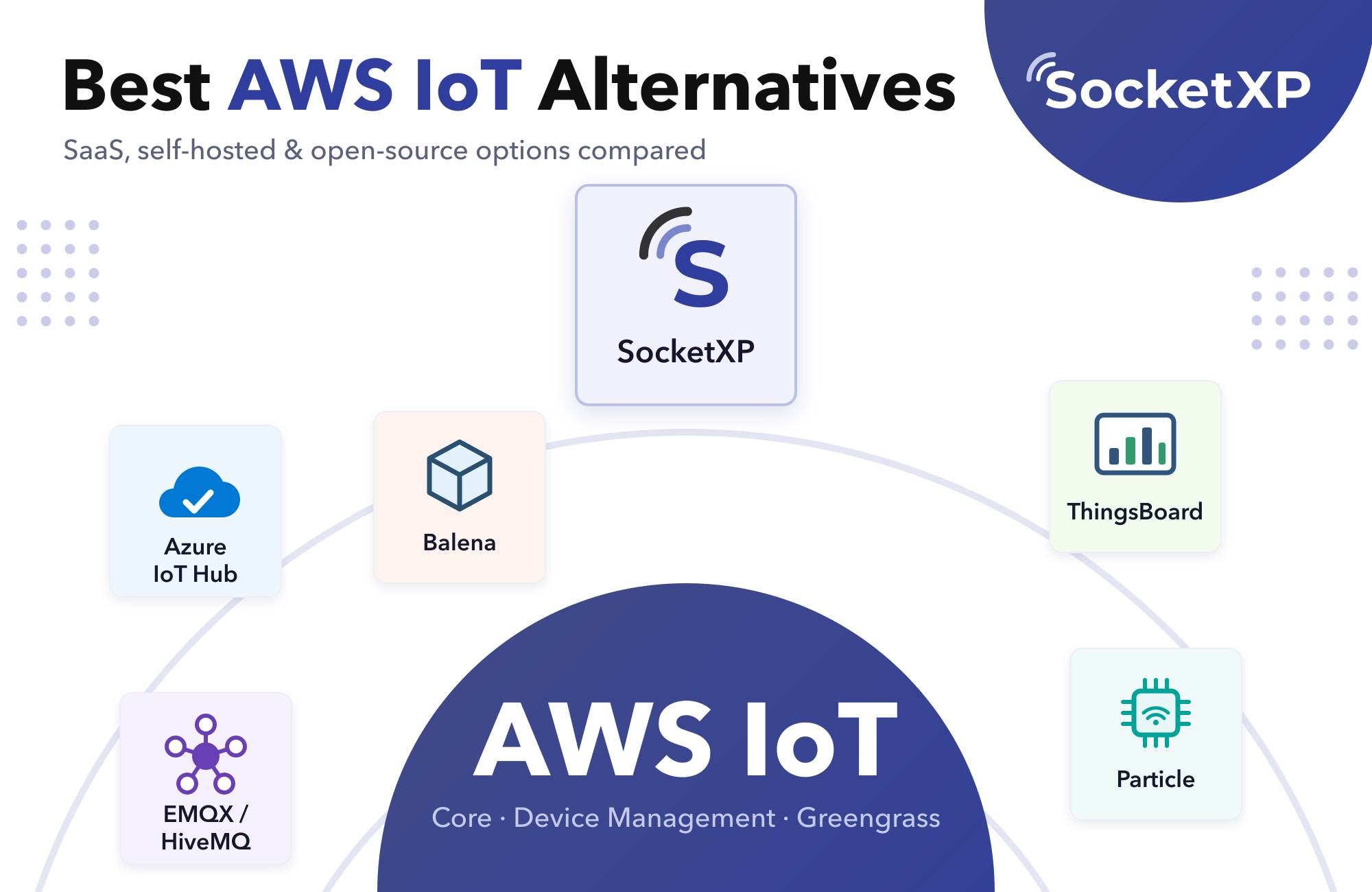
The best AWS IoT alternative depends on which part of AWS IoT you’re replacing. For fleets of Linux-based devices that need remote access, OTA updates, monitoring and fleet management, SocketXP is the best overall choice. It replaces AWS IoT Device Management, Secure Tunneling and the retired Fleet Hub with one lightweight agent and a single web portal, and it’s available as SaaS or self-hosted. It also covers AIoT: remote access and AI model updates for edge AI devices, plus an AI Gateway that lets those devices reach your private LLM server. If you only need an MQTT broker, choose EMQX or HiveMQ. If you need to stay with a hyperscaler, choose Azure IoT Hub. For microcontroller fleets, look at Golioth or Memfault.
Disclosure: SocketXP is our product, so to keep this comparison honest and useful, we rate every platform on the same criteria and say plainly where another tool is the better fit. Pricing was checked in November 2026; vendors change prices often, so confirm on their sites before buying.
- Best overall for Linux and AIoT device fleets: SocketXP. Remote SSH/VNC/web access from the browser, OTA updates, monitoring and fleet management in one platform. SaaS or self-hosted.
- Best self-hosted AWS IoT alternative: SocketXP Enterprise (self-hosted), for data residency and air-gapped use cases.
- Best AWS IoT Secure Tunneling alternative: SocketXP. Persistent outbound tunnels, browser access and no per-tunnel fees.
- Best for AIoT and edge AI fleets: SocketXP. Remote access to Jetson and AI HAT devices, AI model OTA updates, and the SocketXP AI Gateway for reaching private LLMs.
- Best hyperscaler alternative: Azure IoT Hub.
- Best for containerized edge apps: Balena.
- Best hardware + connectivity bundle: Particle.
- Best for microcontroller fleets (Zephyr, ESP-IDF): Golioth.
- Best for MCU crash reporting and observability: Memfault (now part of Nordic Semiconductor).
- Best open-source IoT platform: ThingsBoard Community Edition.
- Best MQTT broker to replace AWS IoT Core messaging: EMQX or HiveMQ.
- Best open-source OTA updates: Mender.
What AWS IoT Is and Which Part You’re Replacing
“AWS IoT” isn’t one product. It’s a family of services you assemble yourself:
| AWS service | What it does | Status in 2026 |
|---|---|---|
| AWS IoT Core | Managed MQTT/HTTPS broker, device registry, rules engine | Active |
| AWS IoT Device Management | Jobs (remote operations/OTA), fleet indexing, Secure Tunneling | Active |
| Fleet Hub | Ready-made fleet monitoring web app | Retired October 18, 2025 |
| AWS IoT Greengrass | Edge runtime for running components on devices | Active |
| AWS IoT Device Defender | Security auditing and anomaly detection | Active |
| AWS IoT Analytics | IoT data processing and analytics | Retired December 15, 2025 |
| AWS IoT Events | Event detection and state machines | Retired May 20, 2026 |
| SageMaker Edge Manager | ML model packaging and deployment to edge devices | Discontinued April 26, 2024 |
Most teams searching for an AWS IoT alternative want to replace one of two things:
- Device management: managing, accessing, updating and monitoring devices (Device Management, Secure Tunneling, Fleet Hub, Jobs). This is where dedicated platforms like SocketXP, Balena and Particle are simpler and more complete.
- Messaging: the MQTT broker in IoT Core. Here, EMQX, HiveMQ or Azure IoT Hub are the direct replacements.
Why Teams Look for AWS IoT Alternatives
- Service retirements. Fleet Hub, IoT Analytics, IoT Events and SageMaker Edge Manager have all been retired, which forced customers to rebuild dashboards, pipelines and edge AI deployments on short notice.
- Complexity. A working setup typically needs IoT Core, IAM policies, per-device X.509 certificates, provisioning templates, Lambda functions and CloudWatch. Each one is a separate thing to learn, secure and pay for.
- Remote access is limited. AWS IoT Secure Tunneling is billed per tunnel opened (the AWS pricing page uses $1.00 per tunnel in its example), each tunnel lasts at most 12 hours, and native clients need AWS’s local proxy running on both the device and your laptop. The AWS IoT console offers browser-based SSH (added in 2022), but there’s no browser-based VNC or remote desktop.
- Usage-based pricing is hard to predict. IoT Core bills per million connection minutes, per million messages (metered in 5 KB chunks), per rule triggered and per registry/shadow operation. Device Management and Secure Tunneling are billed separately.
- Cloud lock-in. AWS IoT can’t be self-hosted, which rules it out for data residency, on-premises and air-gapped requirements.
How We Evaluated These AWS IoT Alternatives
Each platform was assessed on the criteria that matter most when leaving AWS IoT:
- Device management: remote access (SSH, VNC, web), OTA updates, monitoring, remote commands, fleet grouping
- Messaging: MQTT broker capability for telemetry
- Deployment options: SaaS, self-hosted, open source
- Device types: Linux devices (Raspberry Pi, Jetson, gateways) vs microcontrollers (ESP32, nRF, STM32)
- Pricing model: flat and predictable vs usage-based
- Time to first device: how quickly a single engineer can get a device connected and reachable
1. SocketXP: Best Overall AWS IoT Alternative for Linux and AIoT Device Fleets
SocketXP is an IoT device management and remote access platform for Linux-based devices: Raspberry Pi, NVIDIA Jetson, industrial gateways, edge AI boxes, kiosks and embedded Linux. A lightweight agent on each device opens an outbound-only TLS tunnel, so devices behind NAT, firewalls, CGNAT, 4G/5G or Starlink are reachable without port forwarding, a VPN or public IPs.
Replaces: AWS IoT Device Management, Secure Tunneling, Jobs (remote operations and OTA), the retired Fleet Hub, and edge AI model deployment (the role of the discontinued SageMaker Edge Manager).
Key features:
- Browser-based remote access: one click opens an SSH terminal or VNC desktop in the browser. You can also use SSH, VNC, SFTP, RDP or any TCP service with native clients through IoT slave mode.
- OTA updates for apps, Debian packages, Docker containers, firmware and AI model files, with deployment status tracking.
- Remote monitoring and alerting for device health.
- Fleet management: device grouping and tags, remote jobs and commands, mass installation, REST API.
- Security: zero-trust access with no exposed device ports, built-in PKI and mTLS device certificates, SSH key management, short-lived auth tokens, RBAC and audit logs.
- AIoT remote access: SSH and web access to AI edge devices (NVIDIA Jetson, Raspberry Pi with AI HAT+ or Coral, GPU servers), remote Jupyter, TensorBoard and inference APIs, and OTA deployment of AI model files (PyTorch, ONNX, TensorFlow Lite, GGUF) with staged rollouts and automatic rollback.
- SocketXP AI Gateway: one OpenAI-compatible endpoint for OpenAI, Anthropic, Google and your own self-hosted LLMs (Ollama, vLLM, LM Studio). Your private model server connects through an outbound SocketXP tunnel, so AIoT edge devices can call your local LLM from anywhere without a public IP, VPN or open ports. Per-app access keys, policies and request logs included.
- Scales to 100,000+ devices on a single platform (see how).
Deployment options:
- SaaS: SocketXP Cloud in US and EU regions.
- Self-hosted Enterprise: run the SocketXP Gateway on-premises or in any private or public cloud for data residency and air-gapped use cases. Installs from RPM, DEB or Docker Compose, with active-standby high availability. 30-day free trial licence.
- Self-hosted Community edition: free for non-commercial use, for hobbyists, students and evaluations. Up to 100 devices, device management, browser-based SSH/VNC/SFTP access, 2 team members and community forum support.
Pricing: 30-day free trial of all features, no credit card. Paid plans start at $20/month for 40 devices ($0.50 per additional device), with higher tiers adding monitoring, OTA and enterprise features. See SocketXP pricing.
Limitations:
- Not an MQTT broker or analytics pipeline. If you need high-volume telemetry ingestion, pair SocketXP with an MQTT broker (EMQX, HiveMQ or even AWS IoT Core).
- Built for devices that run Linux. Microcontrollers such as ESP32 can be managed through a Linux gateway (see how), but for large fleets of directly connected microcontrollers, Golioth or Memfault are a better fit.
Choose SocketXP if you manage Linux devices or AI edge devices in the field and your main pain is reaching, updating and monitoring them, if your edge devices need secure access to a private LLM, or if you need a platform you can self-host.
2. Azure IoT Hub: Best Hyperscaler Alternative
Azure IoT Hub is Microsoft’s managed device connectivity service and the closest like-for-like replacement for AWS IoT Core.
Replaces: AWS IoT Core messaging, device registry and device shadows (Azure calls them device twins).
Key features: MQTT, AMQP and HTTPS device connectivity; device twins; Device Provisioning Service; Device Update for IoT Hub (OTA); Azure IoT Edge runtime; integration with Azure Stream Analytics, Functions and Fabric.
Pricing: tiered by daily message volume, with a free tier for development.
Limitations: the same hyperscaler trade-offs as AWS: many services to assemble, Azure lock-in, no self-hosted control plane and no built-in browser-based remote SSH/VNC. Microsoft also caused confusion in 2024 when a retirement notice for Azure IoT Central appeared and was then withdrawn as an error.
Choose Azure IoT Hub if your company is standardizing on Microsoft Azure and you mainly need cloud messaging and data integration.
3. Balena: Best for Containerized Edge Applications
balenaCloud deploys and manages Docker containers on fleets of Linux edge devices, running its own balenaOS.
Replaces: AWS IoT Greengrass deployment and Device Management for container-based workloads.
Key features: container-based app deployment, delta updates, balenaOS host OS updates, a web terminal for devices, and the open-source openBalena server for self-hosting (with a reduced feature set).
Pricing: the first 10 devices are free. Paid plans start at around $159/month (Prototype, 30 devices), with Pilot and Production tiers above it.
Limitations: devices must run balenaOS, so it’s hard to adopt on devices already in the field with their own OS. The container-first model adds overhead for simple workloads, and per-device pricing rises quickly at scale.
Choose Balena if your devices run multi-container applications and you can standardize on balenaOS.
4. Particle: Best Hardware + Connectivity Bundle
Particle provides its own microcontroller and cellular modules, Device OS, cellular connectivity and a device cloud as one integrated product.
Replaces: AWS IoT Core plus a separate cellular connectivity provider, for products built on Particle hardware.
Key features: integrated cellular (EtherSIM) and Wi-Fi hardware, OTA firmware updates, device fleet console, integrations to cloud services.
Pricing: a free plan covers up to 100 devices and 100,000 Data Operations per month. Growth plans are sold in blocks of 100 devices.
Limitations: works best with Particle hardware, so it isn’t suited to existing Linux devices or third-party boards. Costs scale with data operations.
Choose Particle if you’re designing a new connected product and want hardware, connectivity and cloud from one vendor.
5. Golioth: Best for Microcontroller Fleets
Golioth is an IoT cloud for microcontroller-based devices, with strong Zephyr RTOS support and SDKs for ESP-IDF and other platforms.
Replaces: AWS IoT Core and Device Management for MCU devices.
Key features: OTA firmware updates, device settings, remote procedure calls, logging, LightDB state and stream data routing to other clouds.
Pricing: since April 2026 Golioth uses usage-based, modular pricing rather than fixed tiers.
Limitations: focused on microcontrollers. It doesn’t offer SSH or VNC remote access for Linux devices.
Choose Golioth if your fleet is Zephyr- or ESP-IDF-based microcontrollers.
6. Memfault: Best for MCU Observability and Crash Reporting
Memfault, acquired by Nordic Semiconductor in June 2025 and being integrated into Nordic’s nRF Cloud, focuses on device reliability: crash reports, core dumps, metrics and OTA for embedded devices.
Replaces: the monitoring, debugging and OTA parts of AWS IoT Device Management for embedded firmware.
Key features: remote crash and core-dump analysis, fleet health metrics, OTA release management. Supports MCUs, Android and embedded Linux.
Limitations: an observability and update tool, not a messaging broker or remote-access platform. Nordic says it will keep supporting non-Nordic hardware, but its future roadmap is tied to Nordic’s nRF Cloud.
Choose Memfault if firmware stability and field debugging are your biggest problems.
7. ThingsBoard: Best Open-Source IoT Platform
ThingsBoard is an IoT platform for data collection, processing, visualization and device management.
Replaces: AWS IoT Core plus the retired IoT Analytics and IoT Events, for dashboards and rule-based processing.
Key features: MQTT, CoAP, HTTP and LwM2M connectivity; rule engine; customizable dashboards; alarms; firmware/software OTA; multi-tenancy.
Deployment and pricing: Community Edition is open source (Apache 2.0) and free to self-host. Professional Edition (self-hosted, commercial) and ThingsBoard Cloud add white-labelling, advanced integrations and support.
Limitations: you run and scale the infrastructure yourself with CE. Remote shell and desktop access to Linux devices aren’t its focus.
Choose ThingsBoard if you want an open-source telemetry and dashboard platform you fully control.
8. EMQX: Best Scalable MQTT Broker
EMQX is a high-performance, clusterable MQTT broker, available self-hosted or as EMQX Cloud.
Replaces: the MQTT messaging and rules engine in AWS IoT Core.
Key features: MQTT 5.0 and MQTT over QUIC, a built-in rules engine and data integrations, and very large connection counts per cluster.
Licensing: from version 5.9, EMQX is distributed under the Business Source License 1.1. That’s source-available, not OSI open source, and clustering in production requires a commercial licence. Earlier Apache 2.0 releases remain available.
Limitations: a broker only. You still need separate tools for remote access, OTA and fleet management.
Choose EMQX if you need a drop-in replacement for IoT Core messaging at large scale.
9. HiveMQ: Best Enterprise MQTT Platform
HiveMQ is an enterprise MQTT platform with a self-hosted broker and a managed HiveMQ Cloud service.
Replaces: AWS IoT Core messaging.
Key features: MQTT 3.x/5 compliance, clustering, extensions, Kafka and database integrations, and enterprise security.
Deployment and pricing: HiveMQ Community Edition is open source (Apache 2.0). HiveMQ Cloud has a free entry tier, and the Enterprise platform is commercially licensed.
Limitations: a messaging platform only. Device management needs a separate tool.
Choose HiveMQ if you’re an enterprise standardizing on MQTT across many systems.
10. Mender: Best Open-Source OTA Updates
Mender is a dedicated over-the-air update manager for embedded Linux devices.
Replaces: AWS IoT Jobs for software and OS updates.
Key features: robust A/B full-system updates with automatic rollback, application updates, delta updates and phased rollouts.
Deployment and pricing: the open-source server (Apache 2.0) is free to self-host. Hosted plans start at around $34/month, with Professional and Enterprise tiers above that.
Limitations: OTA only. Remote access, monitoring and messaging need other tools. Full-system A/B updates require integrating Mender into your OS image (Yocto or Debian).
Choose Mender if robust, rollback-safe OS updates are your main requirement.
AWS IoT Alternatives: Comparison Table
| SocketXP | Azure IoT Hub | Balena | Particle | Golioth | Memfault | ThingsBoard | EMQX | HiveMQ | Mender | |
|---|---|---|---|---|---|---|---|---|---|---|
| Best for | Linux and AIoT device fleets | Azure shops | Container apps | HW + cellular bundle | MCU fleets | MCU observability | Open-source dashboards | MQTT at scale | Enterprise MQTT | OTA updates |
| Remote SSH/VNC from browser | Yes | No | SSH terminal | No | No | No | No | No | No | Remote terminal (paid tiers) |
| OTA updates | Yes | Yes | Yes | Yes | Yes | Yes | Yes | No | No | Yes |
| Device monitoring | Yes | Yes | Yes | Yes | Yes | Yes | Yes | Broker metrics | Broker metrics | Basic |
| MQTT broker | No (tunnels to yours) | Yes | No | No | No | No | Yes | Yes | Yes | No |
| Self-hosted option | Yes (Enterprise + free non-commercial Community) | No | openBalena | No | No | No | Yes (CE + PE) | Yes (BSL) | Yes | Yes |
| Open source | No | No | openBalena | Device OS | SDKs | No | CE (Apache 2.0) | BSL from 5.9 | CE (Apache 2.0) | Yes (Apache 2.0) |
| No inbound ports / works behind CGNAT | Yes | Device-initiated | Yes | Device-initiated | Device-initiated | Device-initiated | Device-initiated | Device-initiated | Device-initiated | Yes |
| Free option | 30-day trial + Community (non-commercial) | Free tier | 10 devices | 100 devices | Usage-based | Check vendor | CE | Single node (BSL terms) | CE / Cloud free tier | Open source |
“Device-initiated” means devices connect out to the broker or server. That traverses NAT for messaging, but it doesn’t give you interactive remote access to the device.
AWS IoT vs SocketXP at a Glance
For the full head-to-head, including a worked cost example for 200 devices and setup steps for each, see SocketXP vs AWS IoT.
| AWS IoT | SocketXP | |
|---|---|---|
| Products to set up | IoT Core + Device Management + Secure Tunneling + IAM + CloudWatch (+ Greengrass) | One agent + one portal |
| Remote SSH/VNC | Secure Tunneling: per-tunnel fee, 12-hour limit, browser SSH only, local proxy for native clients | Persistent tunnels, one click in the browser, or native clients |
| Fleet dashboard | Fleet Hub retired (Oct 2025) | Built-in device portal |
| OTA updates | Jobs + your own update agent and scripts | Built-in OTA for apps, packages, containers, firmware and AI models |
| Device identity | X.509 certificates + IAM policies you manage | Built-in PKI CA, mTLS and auth tokens |
| Pricing | Usage-based across several services | Flat per-device plans from $20/month |
| Self-hosted | No | Yes (Enterprise, plus free Community for non-commercial use) |
| Edge AI (AIoT) | Greengrass ML components; SageMaker Edge Manager discontinued (Apr 2024) | AI model OTA to Jetson and Pi fleets, plus AI Gateway for private LLM access from edge devices |
When You Should Stay on AWS IoT
AWS IoT is still a strong choice if:
- Your devices stream high-volume telemetry into AWS data services (Kinesis, Timestream, S3, SageMaker) and that pipeline is the core of your product.
- You’re all-in on AWS for compliance, procurement and billing.
- You have a platform team that’s comfortable building and running IAM, certificate provisioning and Lambda-based workflows.
Even then, you don’t have to choose one or the other. Many teams keep AWS IoT Core for telemetry and add SocketXP for device management: browser-based remote access, OTA, monitoring and fleet management. The SocketXP agent runs alongside the AWS IoT Device SDK on the same device.
Migrating from AWS IoT to SocketXP
- Inventory what you use. List the AWS IoT services, rules and Jobs you depend on. Decide which ones move to SocketXP (device management, remote access, OTA, monitoring) and which stay (for example, an MQTT pipeline).
- Run both side by side. Install the SocketXP agent on a pilot group of devices alongside the existing AWS IoT setup. No device-side firewall changes are needed, because the agent connects outbound.
- Bake it into your image. Add the agent and its config to your device image or provisioning script, and use mass installation for the existing fleet.
- Move remote access first. Replace Secure Tunneling workflows with SocketXP’s browser SSH/VNC. This is usually the quickest win for support teams.
- Move OTA and monitoring. Recreate Jobs-based updates as SocketXP OTA deployments and set up device health alerts.
- Decommission. Once the fleet is stable on SocketXP, retire the Device Management, Secure Tunneling and IAM resources you no longer need to stop paying for them.
Need to keep everything on your own infrastructure? Start with the self-hosted Enterprise edition (self-hosting guide) instead of SocketXP Cloud.
Related Comparisons
- SocketXP vs AWS IoT: Remote Access, OTA & Pricing Compared
- 6 Best IoT Device Management Platforms in 2026
- IoT Device Management Tools Compared: SocketXP vs Competitors
- Secure Tunneling: The Zero-Trust VPN Alternative for IoT
- What Is an IoT Device Management Platform?
Try the AWS IoT Alternative Built for Device Fleets
Remote access, OTA updates and monitoring for Linux and AIoT devices, as SaaS or self-hosted. 30-day free trial, no credit card required.
Frequently Asked Questions
What is the best AWS IoT alternative?
For fleets of Linux-based devices such as Raspberry Pi, NVIDIA Jetson and industrial gateways, SocketXP is the best overall AWS IoT alternative. It replaces AWS IoT Device Management, Secure Tunneling and the retired Fleet Hub with one agent and one web portal, and it can be self-hosted. If you only need an MQTT broker, EMQX or HiveMQ are better fits. If you want to stay with a hyperscaler, Azure IoT Hub is the closest equivalent.
What replaced AWS IoT Fleet Hub?
AWS ended support for Fleet Hub for AWS IoT Device Management on October 18, 2025, and stopped onboarding new customers in October 2024. AWS points users to the main AWS IoT Device Management console. Teams that want a ready-made fleet dashboard with remote access, monitoring and OTA updates often move to a dedicated platform such as SocketXP, Balena or ThingsBoard.
Is there a self-hosted alternative to AWS IoT?
Yes. AWS IoT is cloud-only. SocketXP offers a self-hosted Enterprise edition you can run on-premises or in any private cloud for data residency and air-gapped use cases, with a 30-day free trial. ThingsBoard Community Edition (Apache 2.0) and Mender (open source) can also be self-hosted, and EMQX and HiveMQ offer self-hosted MQTT brokers.
Is there a free AWS IoT alternative?
Several. ThingsBoard Community Edition and HiveMQ Community Edition are open source. Mender's open-source OTA server is free to self-host. Balena's first 10 devices are free, and Particle has a free plan for up to 100 devices. SocketXP offers a 30-day free trial of all features with no credit card, plus a free self-hosted Community edition for non-commercial use with up to 100 devices.
What is the best alternative to AWS IoT Secure Tunneling?
SocketXP. AWS IoT Secure Tunneling charges per tunnel opened, limits each tunnel to 12 hours, offers browser-based SSH only (no browser VNC or desktop), and needs AWS's local proxy on both ends for native clients. SocketXP keeps a persistent outbound tunnel from each device and lets you open SSH, VNC, SFTP or a web app straight from the browser, or from native clients through its IoT slave mode, without opening any inbound ports.
Can I use SocketXP together with AWS IoT Core?
Yes. Many teams keep AWS IoT Core as their MQTT telemetry pipeline and add SocketXP for device management: persistent browser-based SSH and VNC access without per-tunnel fees, OTA updates, device monitoring and fleet management. The SocketXP agent runs alongside the AWS IoT Device SDK on the same device.
Why are companies moving away from AWS IoT?
The most common reasons are complexity (IAM policies, per-device X.509 certificates and several separate services to stitch together), unpredictable usage-based pricing, cloud lock-in with no self-hosted option, and service retirements. AWS ended SageMaker Edge Manager (April 2024), Fleet Hub (October 2025), IoT Analytics (December 2025) and IoT Events (May 2026), forcing customers to migrate.
What is the best AWS IoT alternative for AIoT and edge AI devices?
SocketXP. It gives you remote SSH, VNC and web access to AI edge devices such as NVIDIA Jetson, Raspberry Pi with AI HAT+ and GPU servers, OTA deployment of AI model files (PyTorch, ONNX, TensorFlow Lite, GGUF) with staged rollouts and rollback, and the SocketXP AI Gateway, which lets edge devices and apps securely call your private, self-hosted LLM server (Ollama, vLLM, LM Studio) as well as OpenAI, Anthropic and Google through one OpenAI-compatible endpoint, with no public IP or open ports. AWS discontinued its edge model management service, SageMaker Edge Manager, in April 2024.
What is the best open-source AWS IoT alternative?
ThingsBoard Community Edition (Apache 2.0) is the most complete open-source IoT platform for telemetry, dashboards and rules. For MQTT messaging, HiveMQ Community Edition is Apache 2.0. Note that EMQX moved to the Business Source License (source-available, not OSI open source) from version 5.9. For OTA updates, Mender's open-source server is Apache 2.0.