
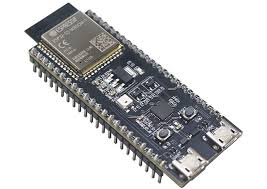
The ESP32 microcontroller has quickly become one of the most popular choices for building IoT projects. With built-in Wi-Fi, Bluetooth, and low-power capabilities, the ESP32 is powerful, affordable, and versatile — making it a favorite among hobbyists, engineers, and startups alike.
In this guide, we’ll explore what ESP32 is, why it’s so useful for IoT development, and the most common applications where it shines, and also compare it with the best IoT microcontrollers available today in the market.
Overview - The Contenders
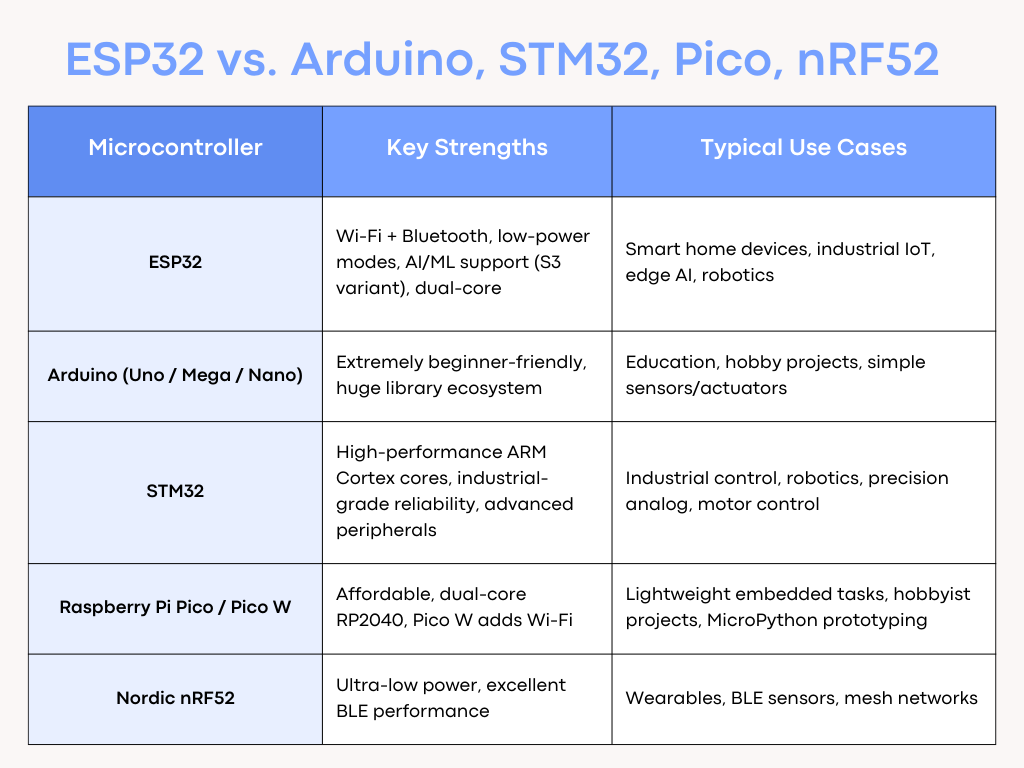
What is ESP32?
The ESP32 microcontroller is a low-cost, low-power system on a chip (SoC) with built-in WiFi and Bluetooth developed by Espressif Systems. It’s the successor to the ESP8266, with significantly more processing power, memory, and connectivity options.
ESP32 Key Features:
Dual-core 32-bit Xtensa processor up to 240 MHz.
Built-in Wi-Fi (802.11 b/g/n) and Bluetooth 4.2 + BLE.
Rich peripheral set: SPI, I²C, UART, ADC, DAC, PWM, touch sensors, CAN bus.
Multiple low-power modes for battery-operated devices.
Secure boot, flash encryption, and cryptographic hardware acceleration.
With these features, the ESP32 is not just another microcontroller — it’s a complete IoT-ready platform.
Prototyped on ESP32 - Now Scaling to Thousands of Devices?
No static IPs, no port forwarding. Just remote access that grows with your fleet.
Why Use ESP32 for IoT Projects?
IoT applications require seamless connectivity, efficiency, and scalability. The ESP32 is designed with these requirements in mind:
Wi-Fi and Bluetooth Built-In ESP32 eliminates the need for external communication modules. It connects directly to local networks, cloud servers, or nearby devices via BLE.
Low Power Consumption Perfect for battery-powered IoT devices, ESP32 supports deep sleep modes that extend battery life for months.
Affordable and Scalable ESP32 development boards typically cost under $10, making them cost-effective for both prototyping and mass deployment.
Large Developer Community Thousands of tutorials, open-source libraries, and active forums make it easy to get started and troubleshoot issues.
Versatility From sensors to robotics, ESP32 supports a wide range of use cases with its GPIO pins and integrated peripherals.
Top IoT Applications Using ESP32
The ESP32’s flexibility makes it suitable for projects across industries. Popular ESP32 IoT applications include:
Smart Home Automation: Control lights, appliances, and security systems over Wi-Fi or BLE.
Wearable Devices: Track fitness and health metrics using low-power Bluetooth connectivity.
Industrial IoT: Monitor machinery, automate workflows, and enable predictive maintenance.
Environmental Monitoring: Collect real-time data from temperature, humidity, or air-quality sensors.
Robotics & Drones: Enable wireless control, motor driving, and real-time telemetry.
Smart Agriculture: Automate irrigation and monitor soil conditions remotely.
ESP32 Development Ecosystem
The ESP32 supports multiple programming environments, giving developers flexibility:
Arduino IDE: Beginner-friendly with prebuilt libraries.
ESP-IDF (Espressif IoT Development Framework): For advanced developers needing full control.
MicroPython: Quick prototyping with Python scripting.
PlatformIO: A professional environment supporting multiple boards and frameworks.
This flexibility ensures the ESP32 works for both hobby projects and enterprise IoT solutions.
ESP32 versus Competitors - Comparison
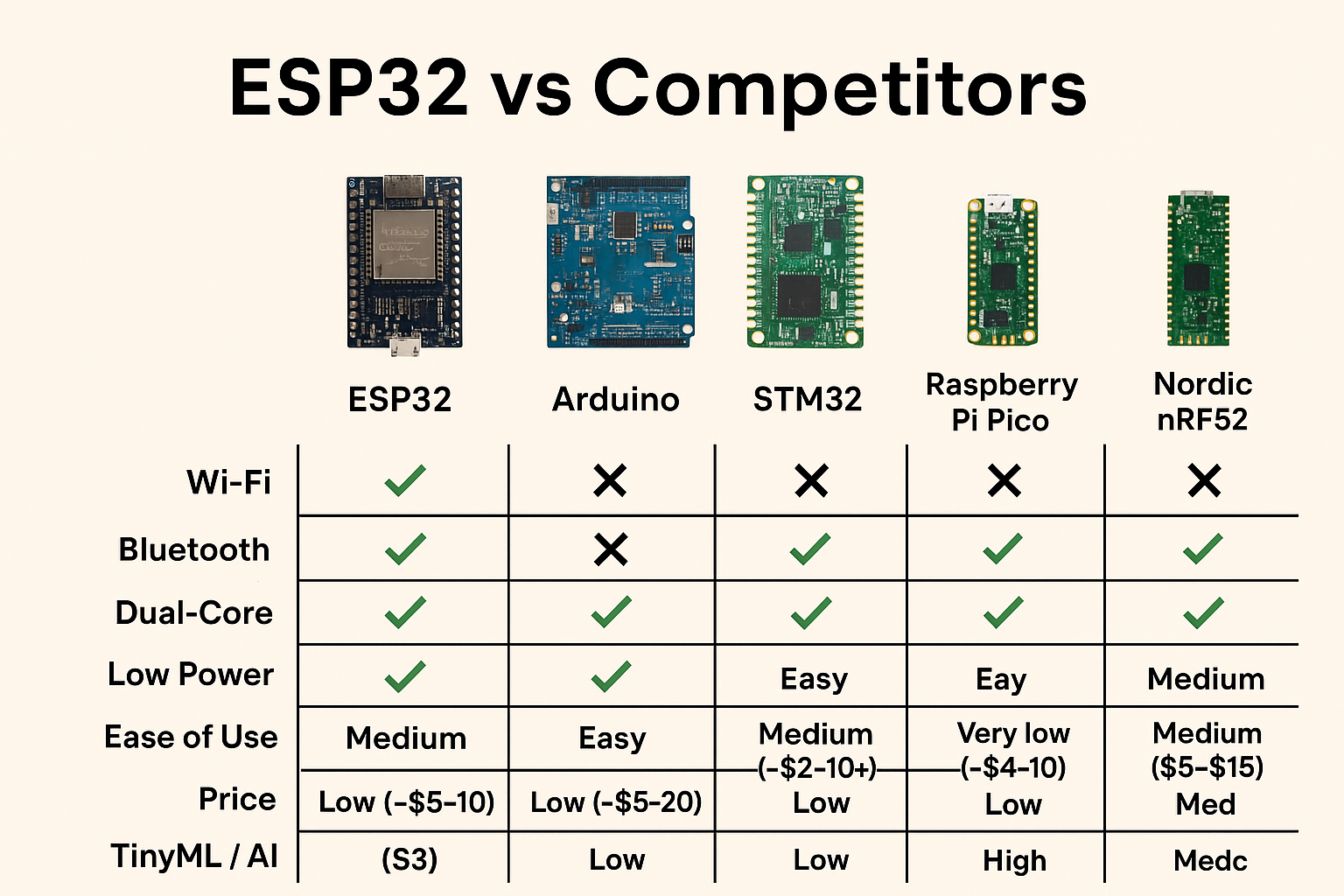
1. ESP32: The IoT Workhorse
The ESP32, developed by Espressif Systems, is designed for modern IoT applications.
Key features:
Connectivity: Wi-Fi 802.11 b/g/n and Bluetooth 4.2 + BLE.
Processing: Dual-core Xtensa 32-bit LX6 up to 240 MHz.
Memory: 520 KB SRAM, optional PSRAM.
Security: Secure boot, flash encryption, TLS/SSL.
Variants: ESP32, ESP32-S2, ESP32-S3 (AI/TinyML support), ESP32-C3 (RISC-V, low-power), ESP32-H2 (Matter/Thread/Zigbee), ESP32-C6 (RISC-V, Wi-Fi 6 802.11ax + BLE 5 + IEEE 802.15.4 Thread/Zigbee/Matter, released 2023), ESP32-P4 (high-performance dual-core Xtensa LX9 up to 400 MHz for edge AI and HMI, no built-in wireless, announced 2024).
Best for: Connected devices that need both wireless communication and local processing power, including smart homes, environmental sensors, and edge AI applications.
2. Arduino: The Beginner-Friendly Choice
Arduino boards like the Uno, Nano, and Mega are beginner staples.
Pros: Simple programming, huge library support, extensive shield ecosystem.
Cons: No built-in Wi-Fi/Bluetooth on classic boards (the Uno R4 WiFi, released June 2023, adds an ESP32-S3 coprocessor for Wi-Fi and Bluetooth; older Uno and Nano boards still lack wireless unless using MKR or Nano 33 IoT variants), limited processing power on classic boards.
Best for: Educational projects, basic sensor/actuator systems, DIY electronics learning; Uno R4 WiFi for beginners who need wireless without switching to ESP32.
3. STM32: Industrial-Grade Performance
STM32 microcontrollers, from STMicroelectronics, are built around ARM Cortex-M cores.
Pros: High-speed processing, precise peripherals (ADC, DAC, timers), scalable family, long product life.
Cons: No built-in Wi-Fi/Bluetooth; steeper learning curve than Arduino or ESP32.
Best for: Industrial automation, motor control, robotics, IoT devices requiring precision and reliability.
4. Raspberry Pi Pico / Pico 2: Affordable Dual-Core Microcontrollers
The Raspberry Pi Foundation’s microcontroller line now spans two generations:
Pico / Pico W (RP2040): Dual-core Arm Cortex-M0+ at 133 MHz, 264 KB SRAM. Pico W adds Wi-Fi 802.11 b/g/n but no Bluetooth.
Pico 2 / Pico 2 W (RP2350, released August 2024): Dual-core Arm Cortex-M33 (or RISC-V) at 150 MHz, 520 KB SRAM, same $5–$7 price point. The Pico 2 W adds both Wi-Fi 802.11n AND Bluetooth 5.2 — closing the wireless gap with ESP32 at entry-level price.
Pros: Cheap, MicroPython support, beginner-friendly, dual-core performance, large Raspberry Pi community.
Cons: Limited peripherals compared to ESP32; Pico / Pico W (original) have no Bluetooth; Pico 2 W is the current recommended version for wireless IoT projects.
Best for: Lightweight embedded tasks, IoT prototypes, MicroPython projects; Pico 2 W for projects needing both Wi-Fi and BLE at low cost.
5. Nordic nRF52 / nRF54: BLE-Centric Ultra-Low Power
The nRF52 series specializes in Bluetooth Low Energy (BLE) applications. Nordic Semiconductor launched the nRF54L series (including the nRF54L15) in 2024 as next-generation successors, offering higher performance, improved security features, and lower power consumption while keeping BLE as the primary wireless interface.
Pros: Excellent BLE performance, ultra-low power, supports BLE mesh networking.
Cons: No Wi-Fi, primarily focused on BLE.
Best for: Wearables, health sensors, battery-powered IoT nodes requiring mesh communication.
Choosing the Right Microcontroller for Your IoT Project
For beginners and simple projects → Arduino Uno R4 or Raspberry Pi Pico 2
For Wi-Fi + Bluetooth IoT devices → ESP32 (classic or variant depending on AI/ML needs), or Raspberry Pi Pico 2 W for simpler workloads
For Wi-Fi 6 + Thread/Matter connected devices → ESP32-C6
For industrial-grade applications → STM32
For BLE-heavy, battery-powered sensors → nRF52 / nRF54
Pro tip: If your project requires mesh networking, OTA updates, and low power, ESP32 and nRF52/nRF54 are the go-to choices, with ESP32 offering broader connectivity options including Wi-Fi 6 (via ESP32-C6).
Remotely Manage your IoT Projects at Scale using SocketXP
SocketXP is an IoT device management platform that can be used to remotely manage, monitor, access, update and control IoT or any embedded Linux devices at very large scale.
SocketXP IoT Management Platform makes it easy to remotely manage 100,000+ IoT devices, that are located behind a NAT router or firewall in your customer’s local network or connected to a Starlink, 4G, 5G mobile cellular network.
SocketXP streamlines and simplifies:
- Device Onboarding and Off-boarding
- Remote Device Management
- Remote Monitoring
- Remote Access
- Remote Configuration
- Remote Debugging
- Remote Software Update (OTA)
- Remote Device Tracking
- Remote Troubleshooting
Frequently Asked Questions
Is ESP32 good for IoT projects?
Yes, the ESP32 is excellent for IoT projects because it has built-in Wi-Fi, Bluetooth, low power consumption, and secure communication features — all at an affordable price.
What can I build with ESP32?
You can build smart home devices, wearables, industrial monitoring systems, drones, robots, environmental sensors, and smart farming solutions with the ESP32.
What is the difference between ESP32 and ESP8266?
The ESP8266 supports only Wi-Fi, while the ESP32 supports both Wi-Fi and Bluetooth. The ESP32 is faster, has more GPIOs, additional peripherals, better security features, and lower power modes.
Can ESP32 run on batteries?
Yes. The ESP32 has multiple low-power modes (like deep sleep), making it ideal for battery-powered IoT devices that need long-term operation.
Which programming languages can I use with ESP32?
You can program the ESP32 using C++ (Arduino IDE), C (ESP-IDF), Python (MicroPython), and JavaScript (via frameworks like Espruino).