
If you’re starting a new Python web project, you’ll run into this question pretty fast: Flask or Django? Both can power the same kind of app, a REST API, a dashboard, a chatbot front end, but they get there in almost opposite ways. Here’s what actually differs between them, and how to pick.
Flask: A Micro-Framework
Flask calls itself a micro-framework, and it means it. Out of the box you get routing and a dev server, and that’s about it. No built-in ORM, no admin panel, no auth system, no fixed project layout. You bolt on what you actually need, when you need it: Flask-SQLAlchemy for a database layer, Flask-Login for sessions, Flask-RESTful or flask-smorest if you’re building an API.
That’s why a minimal Flask app fits in a handful of lines: one app.py file, one @app.route, and app.run(). Nothing to configure, nothing to scaffold.
from flask import Flask
app = Flask(__name__)

@app.route('/')
def hello_world():
    return 'Hello, World!'

if __name__ == '__main__':
    app.run(host='127.0.0.1', port=5000, debug=True)
Django: A Batteries-Included Framework
Django goes the other way entirely. Run django-admin startproject and you get a full project scaffolded for you, settings, a URL router, an ORM already wired up. Django ships with:
- A built-in ORM (Object-Relational Mapper) with migrations
- A ready-made admin interface for managing your data
- Built-in authentication and permissions
- A templating engine, form handling, and CSRF protection, on by default
You pay for that with more structure and more conventions to learn upfront. What you get back is a lot less boilerplate once the app grows past a handful of routes.
Here’s what that looks like in practice: instead of one file, a minimal Django app starts life as a scaffolded project, with its own settings, URL router, and app folder, before you’ve written a single view.
$ django-admin startproject mysite
$ cd mysite
$ python manage.py startapp pages
Define the view in pages/views.py:
from django.http import HttpResponse

def hello_world(request):
    return HttpResponse('Hello, World!')
Then wire it up in mysite/urls.py:
from django.contrib import admin
from django.urls import path
from pages.views import hello_world

urlpatterns = [
    path('admin/', admin.site.urls),
    path('', hello_world),
]
Run the development server, which listens on port 8000 by default:
$ python manage.py runserver 127.0.0.1:8000
Watching for file changes with StatReloader
Django version 5.x, using settings 'mysite.settings'
Starting development server at http://127.0.0.1:8000/
Quit the server with CONTROL-C.
That’s two files and a scaffolded project versus Flask’s one. But admin.site.urls up there already hands you a working, ready-to-use admin interface backed by the ORM. You didn’t write a line of extra code for it.
Flask vs Django at a Glance
Here’s how the two stack up side by side:
| Flask | Django | |
|---|---|---|
| Type | Micro-framework, minimal core, add what you need | Full-stack framework, most things included |
| Project setup | A single file can be a working app | django-admin startproject scaffolds a full structure |
| Routing | @app.route() decorators | Central urls.py with URL patterns |
| Database / ORM | None built-in, typically Flask-SQLAlchemy | Built-in ORM with migrations (makemigrations, migrate) |
| Admin interface | None, build your own or add an extension | Built-in, auto-generated admin panel |
| Authentication | None built-in, Flask-Login, Flask-JWT, etc. | Built-in user model, sessions, and permissions |
| REST APIs | Flask-RESTful, flask-smorest, or plain routes + jsonify | Django REST Framework (the de facto standard) |
| Templating | Jinja2 | Django Template Language (Jinja2-like, DTL by default) |
| Learning curve | Shallow, you can be productive in minutes | Steeper, more concepts to learn (settings, apps, ORM, admin) |
| Flexibility | High, swap any component for another library | Lower, Django has opinions about how things should be done |
| Default dev port | 127.0.0.1:5000 | 127.0.0.1:8000 |
| Best for | APIs, microservices, small tools, prototypes, ML/LLM demo apps | Content-heavy sites, admin-driven apps, larger teams, CMS-style projects |
Recommended Reading: 7 Best Local LLM Tools in 2026 (Hands-On Comparison)
Performance and Ecosystem
Neither framework is what I’d call slow. Both run at real production scale, Flask inside places like Netflix and Airbnb’s internal tooling, Django at Instagram, Disqus, and Pinterest. Flask’s smaller footprint does mean less overhead per request, but in a real app, your database queries and I/O will eat far more time than framework routing ever will.
Where they actually diverge is the shape of their ecosystems. Django’s is centralized: most Django developers reach for the same built-in ORM, the same admin, the same REST Framework, so packages tend to play nicely together. Flask’s ecosystem is scattered by design. You’re assembling a stack yourself from independent packages like SQLAlchemy, Marshmallow, Celery, and Alembic. More choice, but more decisions land on you.
Which One Should You Actually Pick?
When to use Flask:
- You’re building a small API or microservice and don’t need an admin panel or a full ORM.
- You want to wrap an existing model or script, say a thin HTTP layer in front of a local LLM, without dragging in a full framework.
- You want to control every library and architectural decision yourself, instead of working within a framework’s opinions.
- You’re prototyping and don’t want to scaffold a full project just to test an idea.
When to use Django:
- Your app needs user accounts, permissions, and an admin dashboard, and you’d rather not build those from scratch.
- You’re working with a team on a larger codebase, where Django’s conventions keep everyone’s code consistent.
- You need a proper ORM with migrations to manage a database schema that’s going to evolve.
- You want forms, auth, admin, and sane security defaults working correctly out of the box, not assembled from five different packages.
Exposing Either App to the Internet
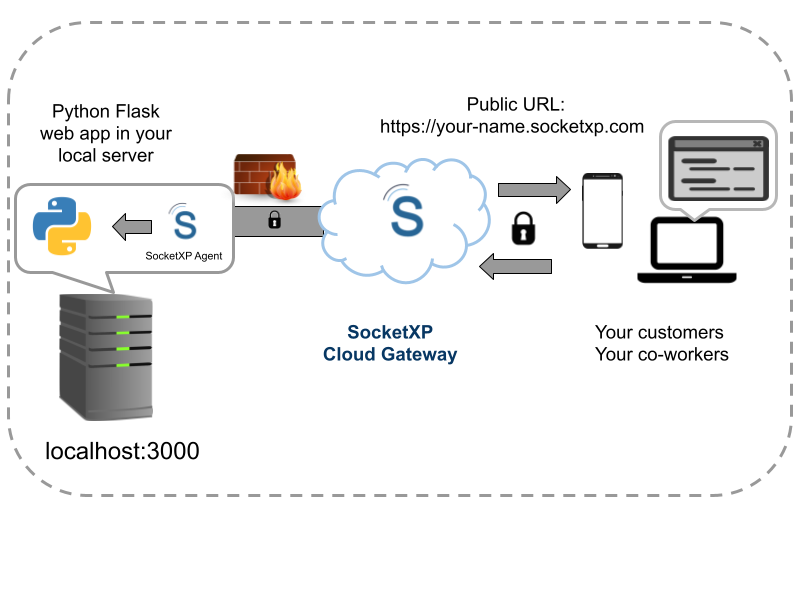
Whichever framework you end up with, exposing the web app running in the localhost to the internet and accessing it via a public web URL works exactly the same way with SocketXP - An HTTP Web Service Remote Access Solution. Only the port changes. Flask defaults to 5000, Django (python manage.py runserver) defaults to 8000.
# Flask app running on port 5000
$ socketxp connect http://localhost:5000

# Django app running on port 8000
$ socketxp connect http://localhost:8000
Both commands hand you a permanent public HTTPS URL, and both work the same behind a NAT router, a corporate firewall, or a CGNAT mobile network. Nothing framework-specific to configure either way.
For the full step-by-step walkthrough, including how to debug common localhost connectivity issues, see How to Remote Access a Python Flask Web App from the Internet.
Frequently Asked Questions
Which is better, Flask or Django?
Honestly, it depends on what you're building, not on which framework is 'better' in general. Flask is the pick if you want a small footprint and full control over your stack. Django is the pick if you want authentication, an admin panel, and an ORM already wired together for you. Look at what your project actually needs on day one, not what might be nice to have someday, and the answer usually becomes obvious.
Which is easier to learn, Flask or Django?
Flask, at least at the start. You can learn the whole framework, routing plus the request and response cycle, in an afternoon, and a working app can live in one file. Django asks you to learn more up front, project structure, the ORM, admin conventions, before you feel productive. The payoff is that once it clicks, Django does a lot more of the work for you on every project after that.
Is Flask good for beginners?
Yes, and it's a decent teaching tool too. Because the framework is so small, you see cause and effect immediately: one decorator, one function, one response, nothing hidden. The catch is that a beginner project eventually needs a database or a login system, and at that point you're researching and installing extensions Django would have handed you for free.
Should I learn Flask or Django first?
Depends what you're trying to get out of it. If you want to actually understand how a web framework works under the hood, start with Flask. Its small surface area makes the concepts easier to see. If you just want to ship something real, with users and a database, as fast as possible, jump straight into Django and learn its conventions on the job, since that's what most Django roles expect anyway.
Is Django overkill for a small project?
Usually, yes. A five-route API or a quick prototype doesn't need Django's ORM, admin site, and auth system sitting there unused. That said, Django earns its keep the moment the project grows a real data model, user accounts, and an admin interface someone actually needs. Just don't reach for it out of habit if the project is genuinely small.
Do big companies use Flask or Django in production?
Both, and at real scale. Django runs Instagram, Disqus, and Pinterest, places where a full-stack framework with a mature ORM and admin tooling suits large, data-heavy apps well. Flask shows up inside companies like Netflix and Airbnb for internal tools and APIs, where a smaller, more flexible footprint fits better than a full framework would.
Is Flask faster than Django?
On a bare route handler, sure, Flask has less overhead since it isn't loading an ORM or an admin app you're not using. But that rarely ends up mattering in a real app. Your database queries, template rendering, and network I/O will dominate response time long before the framework itself does. Pick based on what the framework gives you, not a microbenchmark.
Can Flask do everything Django can do?
Pretty much, functionally. Whatever Django gives you out of the box, an ORM, admin panel, auth, forms, you can bolt onto Flask with a third-party package: Flask-SQLAlchemy, Flask-Admin, Flask-Login, Flask-WTF. The real difference is that Django's pieces already work together and are tested as a set. In Flask, that integration work is on you.
Is Django harder to learn than Flask?
At the start, yes. There's just more to learn up front: settings, apps, the ORM, migrations, the admin site, its own template language. Flask feels easier initially because a working app is one file, but that gap shrinks fast once you're adding the same functionality one extension at a time.
Which is better for building a REST API, Flask or Django?
Both get used heavily for this. Flask, often paired with flask-smorest or Flask-RESTful, is a common choice for smaller, focused APIs that don't need Django's full stack. Django REST Framework is the standard for bigger APIs, especially ones that need to share a database and admin interface with an existing Django app.
Can I switch from Flask to Django later, or vice versa?
Not really, not automatically. The two frameworks handle routing, the ORM, and configuration differently enough that switching means rewriting the application layer, even if your business logic and database schema mostly carry over. Better to make the call upfront using the criteria in this article than to bank on switching down the line.
Which framework does SocketXP work with for remote access?
Both, and it makes no difference to SocketXP which one you're running. It tunnels whatever local TCP port your app listens on to a public HTTPS URL or a private AI Gateway endpoint. Flask on port 5000, Django on port 8000, same 'socketxp connect http://localhost:
' command either way.